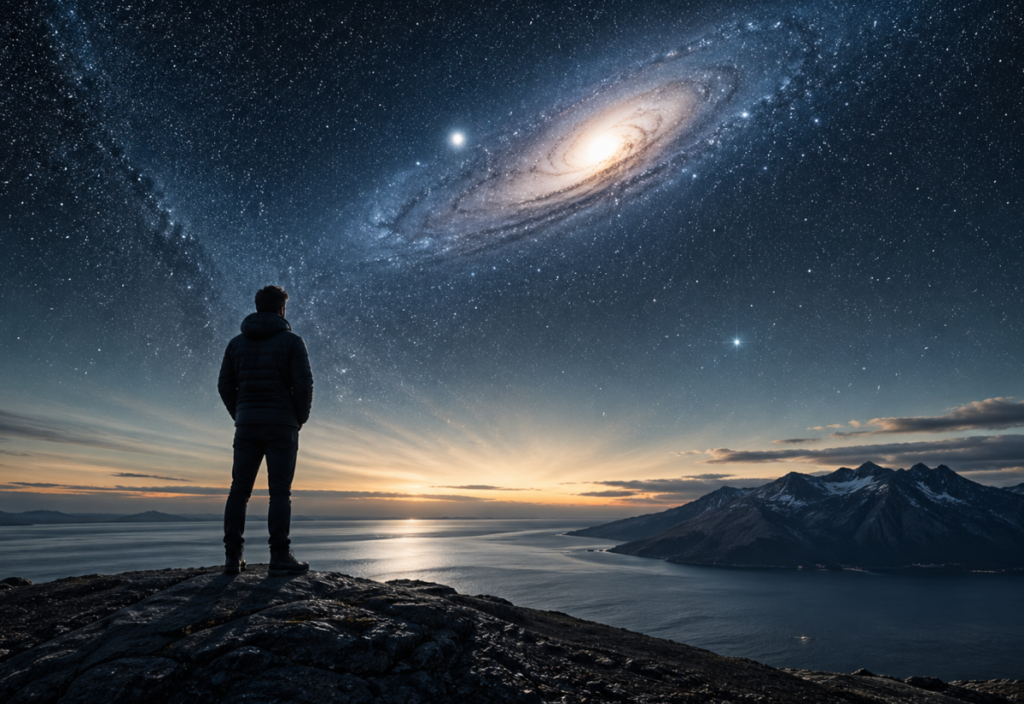
What Does Immensheid Mean?
Immensheid is a Dutch noun derived from the adjective immens — meaning immense, vast, boundless. At its core, it refers to the quality or state of being without measurable limits. The closest English equivalents are immensity, vastness, boundlessness, or infinity — but none of them carry quite the same emotional weight as the Dutch original.
This is more than a dictionary entry. The concept of immensheid describes something humans have grappled with since they first looked upward. It is the quality that makes the night sky humbling, that makes mountains feel ancient, and that makes the ocean seem indifferent to our presence.
Featured Snippet Answer: Immensheid is a Dutch concept meaning immensity or vastness — the quality of something so large, deep, or unlimited that it resists measurement or full comprehension. It applies to the physical universe, philosophical ideas about infinity, and the overwhelming emotional experience of confronting boundless space or scale.
The Philosophy of Immensheid
Philosophy has wrestled with the idea of the immense for thousands of years. From the pre-Socratic philosophers asking what existed before existence, to Kant’s concept of the mathematical sublime, thinkers have tried to locate immensheid within human understanding — and repeatedly found it just out of reach.
Immanuel Kant made one of the most important contributions. In his Critique of Judgment, he distinguished between two forms of the sublime: the mathematical sublime (pure vastness of scale) and the dynamical sublime (overwhelming power). Immensheid aligns precisely with the mathematical sublime — the experience of a scale so great that imagination itself fails to contain it.
Blaise Pascal, centuries earlier, expressed the feeling with startling clarity: faced with the silence of infinite space, a human being feels both terrified and curious. That double movement — fear and wonder — is central to how immensheid operates on us.
Spinoza’s God was, in essence, immensheid made metaphysical. To Spinoza, God and Nature were the same infinite substance — without boundary, without centre, without end. To understand the universe was to participate in something boundless.
More recently, phenomenologists like Maurice Merleau-Ponty explored how the body encounters space. Immensheid is not only a cognitive concept; it is felt in the body when you stand at a cliff’s edge or float in deep water.
Immensheid in the Natural World
Nature is perhaps the most immediate teacher of immensheid. There are places on Earth that make the concept visceral rather than theoretical.
The ocean covers more than 70% of Earth’s surface. Its average depth is 3,688 metres. Its deepest point — the Challenger Deep in the Mariana Trench — descends nearly 11 kilometres. Standing on a beach, you encounter only a fraction of its face, but you sense the weight of what lies beyond the horizon.
Mountain ranges communicate immensheid through time as much as space. The Himalayas began forming roughly 50 million years ago. The Andes stretch nearly 7,000 kilometres. These are not just large — they are old beyond ordinary imagination.
Deserts offer a more austere form of vastness. The Sahara spans approximately 9.2 million square kilometres. Walking within it, the horizon becomes a mathematical concept rather than a geographic one. There is no edge in sight — only continuation.
The Arctic and Antarctic demonstrate immensheid in white silence. Ice sheets that are kilometres thick, formed over hundreds of thousands of years, carry within them a record of every atmosphere the Earth has ever breathed.
The Cosmic Scale: Universe and Immensheid
The observable universe extends approximately 93 billion light-years in diameter. A single light-year is just under 9.5 trillion kilometres. The numbers stop functioning as intuitive guides very quickly and become, instead, symbols of incomprehensibility.
Our own galaxy, the Milky Way, contains an estimated 100 to 400 billion stars. It is one of approximately 2 trillion galaxies in the observable universe. Current estimates suggest there are more stars in the observable universe than there are grains of sand on all of Earth’s beaches — a comparison that has become famous precisely because it stretches the mind to its limit and still falls short.
What makes cosmic immensheid philosophically striking is not just the scale — it is the indifference of that scale. The universe is not vast for us. It is vast without regard for our presence within it. This is what the philosopher Thomas Nagel called the “view from nowhere” — the perspective that reminds us our concerns, however vital they feel from inside, are cosmically negligible.
And yet, paradoxically, the ability to comprehend this immensheid is itself remarkable. As Carl Sagan famously observed, we are a way for the cosmos to know itself. Immensheid contemplating immensheid — that is the strange loop of human consciousness.
Immensheid in Art, Literature, and Culture
Artists and writers have long tried to render immensheid in forms that humans can hold and revisit.
In painting, the Romantic tradition placed tiny human figures against enormous landscapes — not to belittle humanity, but to reveal its peculiar dignity within vastness. Caspar David Friedrich’s Wanderer Above the Sea of Fog is perhaps the most iconic image of this tradition. The figure does not cower; he contemplates. Immensheid is not crushing — it is clarifying.
In literature, Herman Melville’s Moby-Dick is saturated with immensheid. The white whale is not merely an animal; it is the ocean’s way of remaining unknowable. The ocean itself functions as immensheid made narrative.
Walt Whitman’s poetry reaches for cosmic scale in democratic terms. In Song of Myself, he writes as though the self and the universe are continuous — not separate — and therefore the immensheid of the cosmos belongs to everyone.
In music, composers like Gustav Mahler built symphonies of immense duration and orchestral weight specifically to communicate an emotion that ordinary language cannot carry. The ninth symphony, in particular, has been described as an attempt to face the infinite directly.
Contemporary culture finds immensheid in unexpected places — in the long, slow sequences of Andrei Tarkovsky’s films, in ambient music’s patient unfolding, in the silence at the end of a deeply moving experience.
The Psychology of Experiencing Vastness
Psychologists have studied what happens to the mind when it encounters immensheid directly. The results are consistent and surprising.
The emotion most reliably associated with vastness is awe. Research by Dacher Keltner and Jonathan Haidt defines awe as the response to something vast that requires an accommodation of existing mental structures — the ordinary way of making sense of the world is temporarily insufficient.
Awe has measurable effects:
- It slows the perceived passage of time, making people feel they have more time available.
- It reduces self-focused thinking, shifting attention away from personal concerns toward larger frames of reference.
- It increases prosocial behaviour, making people more generous and cooperative.
- It improves physical health markers, including reduced inflammatory markers linked to chronic stress.
In other words, regularly encountering immensheid — whether through astronomy, nature, music, or contemplative practice — appears to be genuinely good for human wellbeing. This finding aligns with what poets and philosophers have suggested for centuries: that confronting vastness puts our smaller preoccupations in a perspective that is both humbling and liberating.
Immensheid in Science and Mathematics
Mathematics is the language in which immensheid becomes precise — and in doing so, reveals its own paradoxes.
Georg Cantor’s work on infinity in the late 19th century demonstrated that not all infinities are the same size. The infinity of counting numbers is smaller than the infinity of real numbers. There are, in a rigorous mathematical sense, more points on a line segment one centimetre long than there are counting numbers — even though both sets are infinite.
This result — which Cantor proved and which most of his contemporaries initially resisted — shows that immensheid has internal structure. It is not a single undifferentiated everything; it has gradations, hierarchies, and surprising relationships.
Cosmological physics encounters immensheid at the edges of measurement. The question of whether the universe is finite or infinite remains genuinely open. Current data suggests it is flat — and a flat universe, in most models, is infinite in extent. We observe only a portion of it because light from more distant regions has not had time to reach us since the Big Bang.
Quantum mechanics adds a different flavour of immensheid: the particle that exists in a superposition of states, the probability wave that extends across space, the entanglement that connects particles regardless of distance. At the smallest scales, immensheid reappears in the form of irreducible uncertainty.
How Humans Relate to the Concept of the Infinite
Every major religious and philosophical tradition has developed an answer to this question. Buddhist cosmology posits countless worlds and vast cycles of time — kalpas so long that even astronomical numbers become metaphors. Hindu cosmology operates on similar scales: Brahma’s day lasts 4.32 billion years, and even this is a fraction of the larger cycles. Abrahamic traditions address immensheid through the concept of a God who is infinite, eternal, and omnipresent — making immensheid not a void but a presence.
Existentialist philosophy takes a different route. For thinkers like Albert Camus, the immensheid of an indifferent universe is the starting point of the human condition — the absurd is precisely the gap between our desire for meaning and the universe’s silence in response. Rather than being defeated by this, Camus argued that we must imagine ourselves content within it.
The Stoics offered another approach: aligning oneself with the logos, the rational principle that permeates the cosmos. Immensheid, in this view, is not alien — it is the nature of the whole, and the human task is to recognise one’s participation in it.
What connects these traditions is not their conclusions but their acknowledgement of the question. Immensheid is not a problem to be solved. It is a reality to be inhabited with curiosity, honesty, and a certain earned quietness.
Conclusion
Immensheid is one of those rare concepts that operates across every domain of human experience — from particle physics to poetry, from the ocean floor to the edge of the observable universe, from a moment of quiet contemplation to the most ambitious works of human art.
It names something that language can point at but not contain: the quality of the boundless, the feeling of being smaller than comprehension allows, and the paradoxical enlargement that comes from facing that reality honestly.
To engage with immensheid is not an escape from ordinary life. It is, if anything, the opposite — a corrective to the narrowing tendency that daily concerns produce. It reminds us that we are participating in something whose scale dwarfs our understanding, and that this participation is not a diminishment but a privilege.
FAQs
1. What is the literal meaning of immensheid?
Immensheid is a Dutch noun meaning immensity or vastness. It derives from the Latin immensus — “that which cannot be measured” — and describes the quality of being without measurable limits or boundaries.
2. How is immensheid different from infinity?
Infinity is a mathematical and philosophical concept referring to something without end. Immensheid is broader — it encompasses the emotional, experiential, and aesthetic dimensions of encountering something so vast it exceeds ordinary comprehension. Infinity is a concept; immensheid is also a feeling.
3. Why do humans find immensheid both frightening and beautiful?
This dual response — terror and wonder — is the hallmark of what philosophers call the sublime. Immensheid destabilises our sense of scale and control, which produces a form of fear. At the same time, it reveals the extraordinary scope of reality, which produces awe and beauty. Both responses can coexist and intensify each other.
4. Can everyday experiences produce a sense of immensheid?
Yes. Stargazing, standing at the ocean’s edge, listening to certain music, reading poetry, deep meditation, and even studying mathematics can all provoke the experience of immensheid. The encounter does not require travel to extreme environments — it requires a quality of attention.
5. How do scientists study immensheid?
Astrophysicists study cosmic scale through observation and modelling. Psychologists study the experience of awe — the emotional response to vastness — through controlled experiments and surveys. Mathematicians formalise infinity through set theory and analysis. No single discipline owns the concept; immensheid is inherently interdisciplinary.