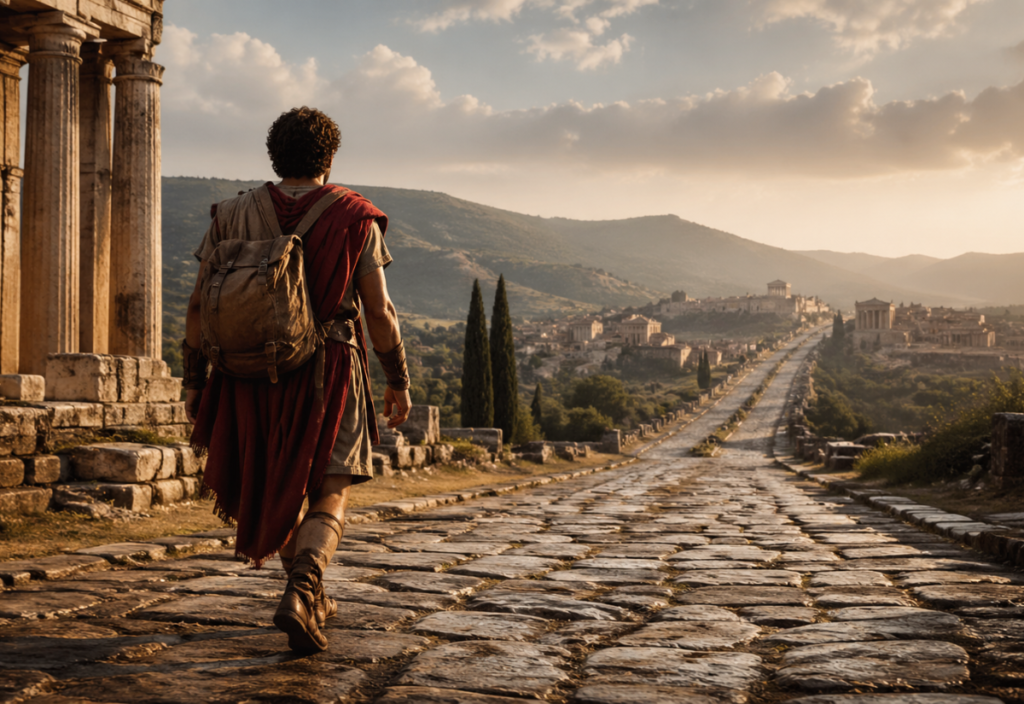
What Is a Cesta Roman?
A cesta roman (literally “journey novel” in Slovak and Czech) is a narrative genre in which a physical journey drives the plot while simultaneously mirroring an inner transformation of the protagonist. The journey serves as both literal action and symbolic metaphor for personal, moral, or spiritual development.
The term “cesta roman” is primarily used in Central European literary criticism, particularly in Slovak and Czech literary theory, to describe fiction structured around travel and movement. In broader international literary scholarship, the same concept appears under names such as the road novel, quest narrative, or travel fiction.
At its core, the cesta roman is defined by a simple but powerful idea: the journey outward reflects a journey inward. The road the protagonist travels — whether across continents, through war zones, or down a highway — becomes a map of their psychological and emotional transformation.
The Origins of the Journey Novel
The journey novel has roots stretching back to antiquity. Homer’s Odyssey is widely regarded as the foundational text of the genre — Odysseus’s ten-year voyage home is inseparable from his inner struggle to remain human in the face of temptation, loss, and violence.
Similarly, Virgil’s Aeneid, Dante’s Divine Comedy, and Cervantes’ Don Quixote all use the journey as a structural and metaphorical backbone. Each protagonist moves through physical space while confronting fundamental questions about identity, morality, and purpose.
By the 18th century, with the rise of the novel as a form, the journey narrative became central to European literature. Novels like Tom Jones by Henry Fielding and Candide by Voltaire used travel across landscapes as a way to expose protagonists — and readers — to society’s full range of experience.
The 20th century brought a distinctly modern mutation: the road novel. Fueled by automobiles, postwar restlessness, and existential questioning, works like Jack Kerouac’s On the Road (1957) transformed the cesta roman into a vehicle for countercultural expression and the search for authentic selfhood.
Key Characteristics of the Cesta Roman
Not every novel featuring travel qualifies as a true cesta roman. The genre has a distinct set of structural and thematic features:
- A departing protagonist: The story begins with a leaving — voluntary or forced — from a familiar home or environment.
- Sequential encounters: The journey is episodic. Each new location or person met serves a narrative function, testing or transforming the protagonist.
- Inner transformation: Physical movement parallels psychological or moral change. The protagonist who arrives at the destination is not the same person who left.
- The road as narrative structure: Unlike novels driven by social interaction in a fixed location, the cesta roman uses forward motion as its primary plot engine.
- A liminal state: The traveler exists between worlds — not fully belonging to the place left behind or the destination ahead — which creates ideal conditions for self-examination.
- Return or resolution: Most journey novels end with either a literal homecoming, arrival at a destination, or the protagonist achieving a new understanding that provides closure.
Types of Journey Novels
The cesta roman is not a monolithic genre. It contains several distinct subforms, each with its own conventions and purposes:
| Type | Focus | Classic Examples |
| Quest narrative | Protagonist seeks a specific goal or object | The Lord of the Rings, The Alchemist |
| Road novel | Open-ended travel; freedom and self-discovery | On the Road, Zen and the Art of Motorcycle Maintenance |
| Pilgrimage narrative | Spiritual or religious journey toward transformation | The Canterbury Tales, The Way of a Pilgrim |
| Exile narrative | Forced departure; grief, survival, identity | The Tin Drum, Breath, Eyes, Memory |
| Coming-of-age journey | Youth traveling toward adulthood and identity | The Adventures of Huckleberry Finn, The Perks of Being a Wallflower |
| Travel memoir / autofiction | First-person autobiographical journey | Wild by Cheryl Strayed, In Patagonia |
Famous Examples of the Cesta Roman
Understanding the genre is best done through its landmark works. Here are some of the most important cesta roman texts in world literature:
The Odyssey (Homer, ~8th century BC) — The original journey novel. Odysseus’s voyage from Troy to Ithaca over ten years is the structural template for every quest narrative that follows. Every obstacle he overcomes reveals something deeper about loyalty, cunning, and the desire to belong.
Don Quixote (Cervantes, 1605–1615) — Often called the first modern novel, Don Quixote follows a man whose obsession with chivalric romances drives him onto the roads of La Mancha. The journey becomes a meditation on illusion, idealism, and the nature of reality itself.
On the Road (Jack Kerouac, 1957) — The defining road novel of the 20th century. Sal Paradise and Dean Moriarty’s cross-country drives across America became the anthem of the Beat Generation, prioritizing experience, spontaneity, and freedom over settled domestic life.
The Alchemist (Paulo Coelho, 1988) — A shepherd boy’s journey from Spain to Egypt in search of treasure has become one of the best-selling novels of all time. Its allegorical simplicity — the idea that the journey itself is the real treasure — captures the spiritual heart of the cesta roman tradition.
Wild (Cheryl Strayed, 2012) — A memoir-style journey novel in which Strayed hikes 1,100 miles of the Pacific Crest Trail alone following personal loss and addiction. A masterclass in how physical hardship becomes an engine for emotional recovery.
Cesta Roman vs. Bildungsroman: What’s the Difference?
These two genres are closely related and frequently overlap, but they are not the same thing. Understanding the distinction matters for both literary analysis and creative writing.
A Bildungsroman (coming-of-age novel) focuses primarily on the psychological and moral development of a young protagonist as they transition from youth to adulthood. The setting can be relatively fixed — a school, a town, a household — and development occurs through relationships, failures, and accumulated experience over time.
A cesta roman, by contrast, uses physical movement as the primary driver of change. The road is not merely a backdrop — it is the mechanism. Encounters happen because the protagonist is moving. The landscape itself becomes a character. Transformation is inseparable from travel.
Many great novels are both simultaneously. The Adventures of Huckleberry Finn, for instance, is a coming-of-age story (Bildungsroman) driven entirely by a river journey (cesta roman). The distinction is useful analytically even when the categories blend in practice.
The Cesta Roman in Slovak and Czech Literature
Within Central European literary tradition, the cesta roman occupies a particularly meaningful place. Slovak and Czech authors have produced a rich body of journey narratives that reflect both universal themes and the specific historical experiences of their cultures — including forced displacement, political exile, and the search for national identity.
Notable Slovak examples include travel-themed prose from authors such as Janko Jesenský and Milo Urban, whose narratives of movement through rural and urban Slovak landscapes carried deep social commentary alongside personal transformation.
The cesta roman as a concept is taught widely in Slovak secondary and university literature curricula, where students analyze how the journey structure functions as a metaphor for broader national, historical, or personal themes.
In Czech literature, authors like Karel Čapek — whose travel writings blended personal observation, philosophy, and humor — expanded the form beyond fiction into a literary essay-journey hybrid that influenced how Central European readers and writers think about travel writing as a serious literary genre.
Why the Journey Novel Still Matters Today
In an era of instant travel and digital connection, one might expect the cesta roman to feel dated. The opposite is true. The genre has never been more relevant.
Contemporary readers are drawn to journey narratives precisely because physical movement offers something the internet cannot: genuine uncertainty, embodied experience, and encounters that cannot be curated or filtered. The road remains one of the last spaces in literature where transformation feels genuinely earned.
Modern cesta roman works span literary fiction, memoir, and genre fiction. They explore themes like climate migration, refugee experience, and postcolonial identity alongside the timeless questions of love, loss, and purpose. Writers such as Yaa Gyasi, Valeria Luiselli, and Ocean Vuong use journey structures to investigate how movement shapes identity across generations and cultures.
The rise of the travel memoir as a dominant publishing category reflects the cesta roman’s enduring appeal. Readers consistently respond to narratives that combine a vivid physical journey with honest introspection — proof that the genre’s core formula remains as powerful today as it was for Homer.
How to Write a Cesta Roman
If you’re a writer drawn to this genre, several structural principles will help you build a compelling journey novel:
- Establish what the protagonist is leaving — and why it matters. The home they depart must feel real and weighted. Readers need to understand what’s being risked by leaving.
- Map the outer journey onto an inner one. Every major location change should correspond to a shift in the protagonist’s understanding, beliefs, or emotional state.
- Use secondary characters as mirrors. The people a traveler meets should reflect, challenge, or complicate the protagonist’s self-image.
- Let the landscape do work. Settings in a cesta roman are not neutral. A desert conveys isolation; a crowded city conveys anonymity; a mountain conveys difficulty and perspective. Choose settings with thematic intention.
- Resist the temptation to make the arrival the point. In the best journey novels, what matters is who the protagonist becomes along the way, not whether they reach the destination.
- Balance action with interiority. The road novel lives in the space between external event and internal response. Too much action becomes a plot summary; too much reflection becomes an essay. Maintain the tension between both.
Conclusion
The cesta roman is far more than a genre about getting from one place to another. It is literature’s oldest and most honest way of exploring what it means to change — and how change requires movement, risk, and the willingness to leave the known world behind.
From Homer’s wine-dark sea to a dusty Pacific Crest Trail, from the roads of La Mancha to the highways of postwar America, the journey novel has always asked the same essential question: who will you become by the time you arrive?
Whether you are studying the genre, looking for your next great read, or setting out to write your own cesta roman, understanding this tradition connects you to thousands of years of storytelling at its most fundamental. The road is always open. The only question is whether you’re ready to take it.