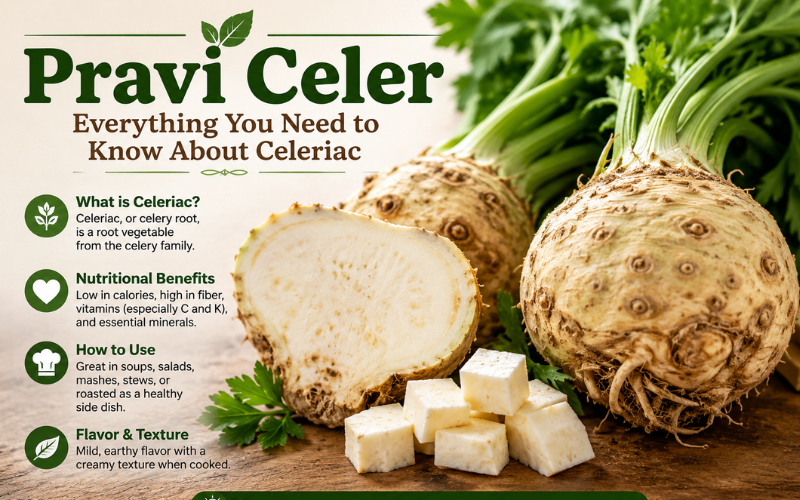
If you’ve ever wandered through a farmers’ market or a well-stocked grocery store and spotted a knobby, rough-skinned root vegetable that looks like a turnip’s eccentric cousin — you’ve likely encountered pravi celer, also known as celeriac or celery root. Despite its somewhat unglamorous appearance, this vegetable has been quietly winning over chefs, nutritionists, and home cooks for centuries.
But what exactly is pravi celer? How is it different from the stalky celery you toss into soups? And why should it earn a regular spot in your kitchen? This guide covers everything — from its botanical identity and nutritional profile to cooking techniques, health benefits, and how to grow your own.
What is Pravi Celer (Celeriac)?
Pravi celer is the South Slavic name for celeriac — a root vegetable botanically classified as Apium graveolens var. rapaceum. While the name literally translates to “real celery” or “true celery” in several regional languages, celeriac is better understood as a celery variety specifically bred for its swollen, edible taproot rather than its stems.
The bulb is typically round, with a rough, furrowed exterior and dense, pale ivory flesh inside. It carries a flavor that is earthy, slightly nutty, and unmistakably reminiscent of celery — but milder, richer, and more complex once cooked. Celeriac has been cultivated in Europe since at least the 17th century and remains a staple across Central and Eastern European cuisines, including Serbian, Croatian, Bosnian, and Slovenian cooking.
Unlike many root vegetables, celeriac is relatively low in calories and starch, making it a favorite among people following low-carb or ketogenic diets as a substitute for potatoes.
Pravi Celer vs. Regular Celery: Key Differences
People frequently confuse pravi celer with ordinary stalk celery, but the two are meaningfully different in appearance, taste, texture, and culinary application.
| Feature | Pravi Celer (Celeriac) | Regular Celery (Stalk Celery) |
| Botanical variety | A. graveolens var. rapaceum | A. graveolens var. dulce |
| Edible part | Root/bulb | Stalks and leaves |
| Flavor profile | Mild, earthy, nutty | Sharp, bright, vegetal |
| Texture when cooked | Creamy, dense (like potato) | Softens but remains fibrous |
| Raw use | Yes, grated or sliced thin | Yes, as crudités or in salads |
| Carbohydrates (per 100g) | ~9.2g | ~3g |
| Shelf life (raw) | Several weeks refrigerated | 1–2 weeks refrigerated |
The most important practical difference: pravi celer is cooked and eaten as a vegetable in its own right, while regular celery tends to serve a supporting role as an aromatic or garnish. In traditional Balkan cooking, pravi celer is as essential to a slow-cooked stew or clear broth as a carrot or onion.
Nutritional Value and Health Benefits
One reason chefs and nutritionists alike are enthusiastic about pravi celer is its remarkably strong nutritional profile relative to its modest calorie count. A 100-gram serving of raw celeriac contains roughly 42 kcal, making it an excellent choice for anyone managing weight without sacrificing nutrient density.
Key nutrients in pravi celer include:
- Vitamin K — essential for blood clotting and bone metabolism; celeriac is one of the more generous plant sources.
- Vitamin C — supports immune function and skin health; approximately 8mg per 100g raw.
- Phosphorus and potassium — important for cardiovascular health, muscle function, and fluid balance.
- Dietary fiber — promotes digestive health and helps sustain satiety.
- B vitamins — including B6, folate, and small amounts of B1 (thiamine), supporting energy metabolism.
Because pravi celer has a much lower glycemic index than potatoes, it is increasingly popular in diabetic-friendly recipes and low-carbohydrate meal plans. Its antioxidant content — including compounds like phthalides and polyacetylenes — has also attracted interest in functional nutrition research, particularly regarding anti-inflammatory effects.
Notably, pravi celer contains apigenin, a flavonoid studied for potential cardiovascular and neuroprotective properties. While research is ongoing, early findings are encouraging for this humble root vegetable’s role in preventive nutrition.
Culinary Uses: How to Cook with Pravi Celer
The versatility of pravi celer in the kitchen is one of its most underappreciated qualities. It performs well across an exceptional range of cooking methods, adapting to both delicate and robust flavor profiles.
Popular culinary applications include:
- Soups and broths — Pravi celer is a cornerstone of traditional Balkan clear meat broths and vegetable soups, contributing depth and a subtle celery fragrance without overpowering other ingredients.
- Roasted or baked — Cut into wedges or cubes, roasted celeriac develops a golden crust and sweet, concentrated flavor comparable to roasted parsnip or turnip.
- Purée — Boiled and blended with butter and cream, celeriac makes a luxuriously smooth purée that rivals mashed potato in comfort and texture.
- Raw in salads (rémoulade) — Julienned or coarsely grated and dressed with mustard-based vinaigrette, celeriac rémoulade is a classic French and Central European cold dish with a satisfying crunch.
- Gratins and bakes — Thinly sliced, layered with cheese and cream, and baked — a straightforward substitution in any potato gratin recipe.
- Stir-fries and sautés — Diced celeriac takes well to high-heat cooking, developing a pleasant caramelized edge.
- Chips and fries — An increasingly popular low-carb alternative to potato fries, baked or air-fried until crisp.
In the cuisines of the former Yugoslav region, pravi celer appears in everything from holiday chicken soups to slow-braised beef dishes, where it is often added alongside carrots, parsley root, and kohlrabi as part of a classic aromatics bundle.
How to Prepare and Store Celeriac
Preparing pravi celer intimidates some first-time cooks because of its rough, irregular exterior. However, the process is simple once you know what to expect.
- Trim the top and bottom — Use a sharp, heavy knife to cut off the leafy crown and the root base, creating flat, stable surfaces.
- Peel with a knife, not a peeler — The skin is too thick and uneven for a standard vegetable peeler. Use a paring knife or chef’s knife to cut away the outer layer, following the curve of the bulb.
- Submerge immediately in acidulated water — Like potatoes, celeriac flesh oxidizes and turns brown upon contact with air. Place peeled pieces straight into water with a squeeze of lemon juice or a splash of vinegar.
- Cut to your intended use — Dice for soups and stews, slice thinly for gratins, cut into matchsticks for raw salads, or quarter for roasting.
Storage tips: An unpeeled pravi celer will keep for two to four weeks in the refrigerator crisper drawer, or up to two to three months in a cool, dark cellar. Once peeled and cut, store submerged in acidulated water and use within two to three days. Blanched celeriac can be frozen for up to three months.
Growing Pravi Celer at Home
Pravi celer is a slow-growing but ultimately rewarding crop for home gardeners, particularly in temperate climates. It requires a long growing season — typically 100 to 120 days from transplanting — and benefits from cool temperatures, consistent moisture, and fertile, well-draining soil.
Key growing guidelines:
- Start seeds indoors 10–12 weeks before the last frost date. Celeriac seeds are small and slow to germinate; maintain consistent soil moisture at 18–21°C for best results.
- Transplant outdoors once nighttime temperatures stay reliably above 10°C, spacing plants 30–40 cm apart in rows 45 cm apart.
- Soil preparation — Celeriac thrives in rich, loamy soil with a pH of 6.0–7.0. Work in generous amounts of compost before planting.
- Watering — Keep soil consistently moist. Irregular watering leads to cracked bulbs and bitter flavor. Mulch heavily to retain moisture.
- Blanching the root — As the bulb develops, remove the lower leaves to expose the crown and encourage a smoother, larger root.
- Harvest — Bulbs are typically ready when they reach 8–12 cm in diameter. A light frost before harvest actually sweetens the flavor.
Growing pravi celer from seed takes patience, but the ability to harvest fresh roots through autumn and into early winter makes it a valuable addition to any kitchen garden.
How to Buy the Best Pravi Celer
When shopping for pravi celer, choosing the right specimen makes a meaningful difference to both ease of preparation and final flavor. Here is what to look for:
- Weight relative to size — Choose bulbs that feel heavy for their size. Lightweight celeriac may have a hollow, spongy center.
- Firm texture — Press the bulb gently; it should feel dense and solid throughout, with no soft spots.
- Relatively smooth skin — Some knobbiness is normal, but excessively furrowed or deeply creviced roots are harder to peel with less usable flesh.
- Moderate size — Medium bulbs (roughly the size of a large orange or small grapefruit) tend to have better flavor and texture than very large ones, which can become woody.
- Fresh greens — If the leafy tops are still attached, they should look crisp and green rather than wilted or yellowed. The greens themselves are edible and can be used like celery leaves.
Pravi celer is available year-round in many markets across the Balkans and Central Europe, with peak season running from September through March. In spring and summer, availability may be more limited.
Best Substitutes for Pravi Celer
If pravi celer is unavailable, several vegetables can fill a similar role depending on context:
| Substitute | Best Used When | Flavor Match |
| Parsnip | Soups, roasting, purée | Sweeter, earthier — good in broths |
| Turnip | Stews, boiling, gratins | Slightly more peppery; good texture match |
| Kohlrabi | Raw salads, light cooking | Milder; similar crunchy-to-tender transition |
| Potato | Mash, gratins, soups | Neutral; lacks celery note — add celery seed |
| Celery stalk + carrot | Soups and aromatics | Combined, approximates the fragrance reasonably well |
None of these substitutes perfectly replicate the characteristic flavor of pravi celer, but in cooked applications, parsnip or turnip come closest in terms of texture, while a combination of celery stalks and a small amount of celery seed most closely approximates the aromatic signature.
Conclusion
Pravi celer is one of those quiet overachievers in the vegetable world — overlooked by many, celebrated by those who know it well. Whether you are drawn to its deep, complex flavor in broths and stews, its versatility as a low-carb potato substitute, its impressive nutritional density, or its straightforward appeal as a winter storage vegetable, there is something here for every kind of cook.
From the hearty soups of traditional Balkan cooking to the refined purées of modern European fine dining, pravi celer has earned its reputation as the “real” celery — a root that earns its place on both the everyday table and the special occasion menu.